
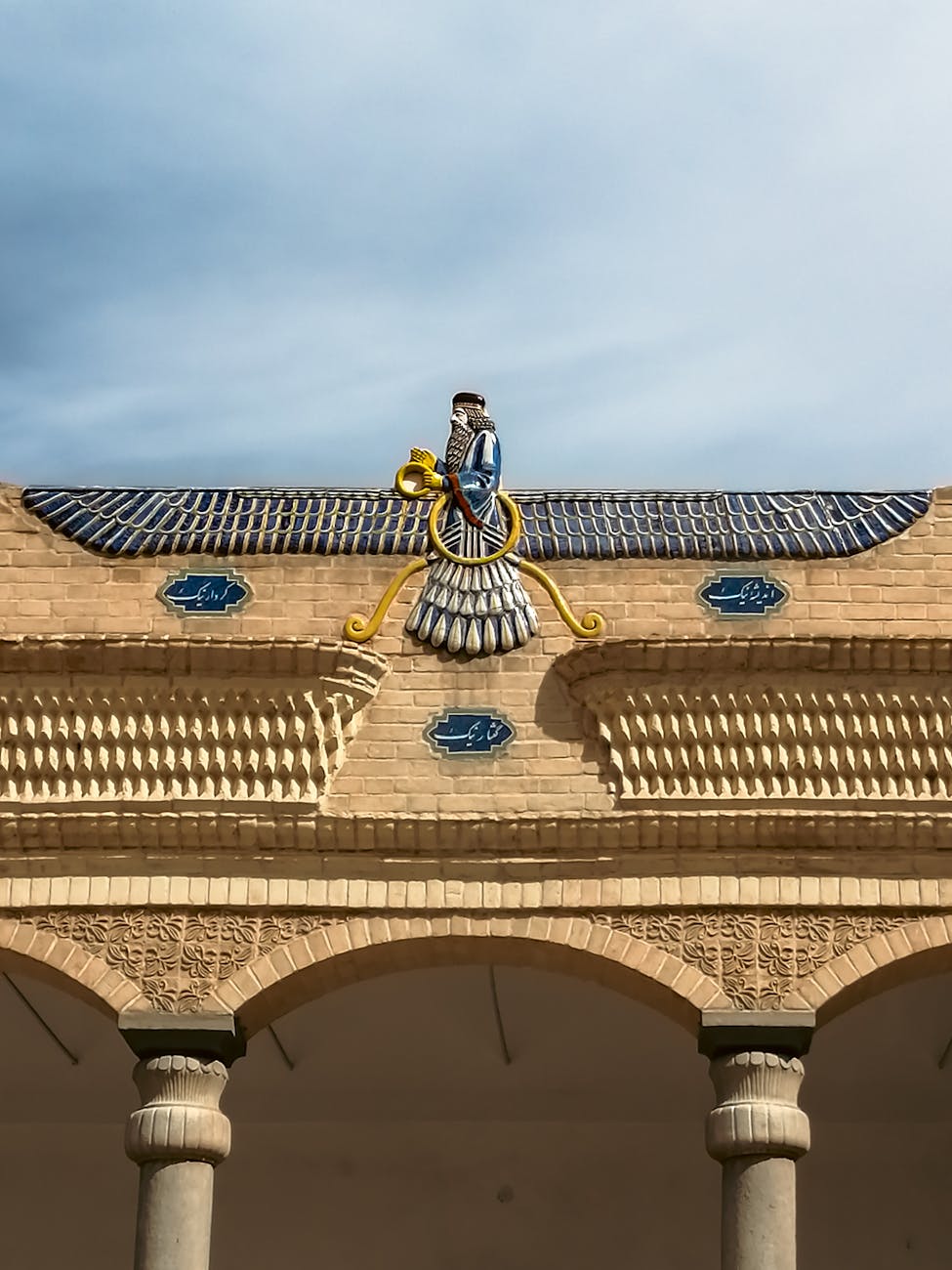
Zoroastrian Perspective: Philosophy, History, Culture
Last Wednesday, I emailed Parzor Foundation, alerting them that my father might be the last Burmese Zoroastrian alive and asking if they’d be interested in interviewing him for their UNESCO project. I found them because I’d started rereading the Gathas.
A resounding yes arrived Thursday, accompanied by a personal invite to take the TISS-PARVOR Academic Programme in Culture & Civilisation: A Zoroastrian Perspective and attend the orientation session on Friday.
Gulp!
This reminded me of attending a consultation for a sleep study and finding myself enrolled lickety split in a study of controlled-release pregabalin. That out-of-the-blue adventure led me to gamma brainwave biofeedback, which radically and swiftly improved my intellectual capacity among other things.
What will this out-of-the-blue invite lead to?
I don’t know.
But I’m going to try and write up some key concepts after each session in order to cement what I’m learning.

Today was day one of the Foundation course for the program (or should I use the Indian spelling: programme?). The introductory lecture firehosed information into my brain, lighting up neurons, setting fire to my neural networks, overloading the synapses. I went for a walk afterwards to try and verbalize what I’d visualized — in the way that Lindamood-Bell had taught me to read for comprehension.
But my mind kept wandering. Maybe writing is better?
Introduction and Major Tenets
Parzor Foundation arose out of the UNESCO’s Memory of the World project to counter the world’s descent into collective amnesia. UNESCO invited Shernaz Cama to recover Zoroastrian memories. I had known Zoroastrianism was on the decline, that our numbers are small, but I hadn’t realized that this demographic is on the brink of extinction. The Parzor Foundation was set up to recover the population; the program to counter misinformation and fill in the enormous gap in which august institutions simply cut Zoroastrianism out of their historical accounting of the great civilizations.
Long-time followers may recall I was miffed at the British Museum’s mischaracterization of Zoroastrian artifacts.
Anyway, before brain injury fatigue comatoses my mind, I’ll outline three key concepts as I understand them.
1. Intangible <=> Tangible
People often think of culture as tangible: food, clothing, performance art, sculptures. But Zoroastrianism is more than food and clothing. It’s an oral tradition culture that exists in the mind: the intangible. The key concept of good thoughts, good words, good deeds, begin in the mind, an intangible place.
The intangible may lead to the tangible, but culture begins with the former.
Language
Language is the bedrock of culture. When languages disappear, their associated cultures erode and disappear as well. I’ve noticed that when people switch languages, their voices change intonation and pitch. They may speak slower or quicker. They may speak with harsher sounds or softer sounds. These changes seem to reflect behaviour and how people are in the world, ie, their cultural expression.
Although language is an intangible, as in oral memories, it can lead to tangible expressions such as books, poetry, or this post.
2. Zarathushtra: Both Real and Myth
Zarathushtra was an historical figure, a man who actually lived, a man who married, had children, and was murdered.
Yet myths surround his birth and death. The myths around his conception and infanthood convey the battle of evil against the good that Zarathushtra had been appointed by God to bring to a conflicted world. Gaush Urva pleaded for help, and Ahura Mazda sent Zarathushtra.
Myths: At his birth, Zarathushtra laughed instead of cried, as newborns usually do. Three times evil tried to kill him. But fire turned to a bed of roses; a stampeding herd included a white bull who stood over him to protect him from the hooves; and a wolf den became a place of nurturing and sibling play.
Real: Zarathushtra was kind. He saw men and women as equals. He acted compassionately towards suffering animals. And he gave tangible assets to the poor.
Real and Myth: At 77, while praying, he was murdered. Two myths surround this historical act. He was said to have thrown his prayer beads at his murderer. Either he threw the beads, forgiving the man, or he threw the beads and the man died on the spot. It’s our choice which one to believe, which one seems more in keeping with Zarathushtra’s character. Personally, I believe the former more than the latter. A kind man doesn’t suddenly become vengeful as his last act.
3. Diaspora
Diaspora means to scatter. Up until 50 years ago, Zoroastrians held on to their core beliefs through three empires, becoming refugees, adjusting to a new land, enduring hardship in a cold desert, and growing wealth in a bustling city. Then suddenly, the population began to fragment and lose their culture. The world began to forget about us. Why?
My mother suggests it’s intermarriage. Cama said that Zoroastrians allow conversion. That’s pretty new from my experience. I was banned from the Navjote because my mother is British. That was reversed in the 21st century, maybe 10 or 15 years ago. A bit late for me. In addition, my father taught me that Zoroastrianism prior to the conquest was an evangelical religion. Evangelism is not the same as conversion. So, in a sense, Zoroastrianism hasn’t fully returned to its roots of inclusion.
Diaspora also means to sow. And so in the scattering, seeds sprout new life.
A Personal Perspective
On a personal note, when Cama began talking about this conundrum of Zoroastrianism having survived major upheavals and genocidal assaults only to face doom in a modern world, my eyebrows shot up. I’ve been mulling for many, many years why Zoroastrians were decimated. It’s like God has decided that now is the time for me to both begin to answer that question and learn about my identity.
What is a Zoroastrian?
As I walked in the cold southwest wind and tried to recall the lecture, I realized that we hadn’t really defined what is a Zoroastrian. The Burmese community my Dad was born into debated this question so fiercely that they took it to court. Typical!
Recently, someone declared I’m not. Say what now?! My DNA would beg to differ. I learnt during the orientation session and this morning’s first lecture that many are seeking identity, like I am.
Brain injury killed me off. I spent decades rocked by not knowing who I am, unhelped by continual changes in my talents, skills, abilities, emotions, intellect, physical health, physical ability, processing speed, reading and writing abilities, and energy levels. Not having a group identity worsened the sense of identity-motion sickness. Grief at loss of myself — what I call brain injury grief — gripped me.
As Cama talked about aspects of Zoroastrian culture and peoples, I heard aspects of myself, aspects I hadn’t known came out of my Zoroastrian side. Perhaps the osmotic process that Cama had said faded in the last 50 years still worked in my life, from my grandparents, uncles, and father into me without me realizing it.
Anyway, I have to go hunt down a book. My year was already challenging between revising my third novel (The Soul’s Turning), my desire to redesign my brain injury website, and my ongoing air-to-water heat pump problems the city had instigated by allowing sediment into our clean, drinking water. I really must be bonkers. But my brain and mind love a challenge in spite of the fatigue. And this may calm the identity upset and fill in what I feel is missing from The Soul’s Turning draft.
So what is a Zoroastrian? Three options come to mind.
- A human being who’s taken the Navjote.
- A human being who hasn’t taken the Navjote but follows the foundational tenet of Good Thoughts, Good Words, Good Deeds.
- A human being who has a Zoroastrian parent, grandparent, or great-grandparent. Canada has over time changed its definition of who can register as First Nations, for example, by addressing gender inequities. I’ve been aware through the news of this kind of wrestling over determining who has status under the law and who declares themself to be First Nations or who belongs to a First Nations band. I believe that if Zoroastrians want to reverse the extinction trend, the communities around the world need to have serious discussions about this. Personally, DNA should be more relevant than whether or not one underwent the Navjote if we want to resurrect the population.
